Legacy QA
Clicks UI buttons and inspects pixel states, remaining completely blind to backend payload drift and broken schema contracts.
Blind spot: API contracts & payloads
Post a Shutout on Silent Pipeline Failures.
Your teams and AI coding tools ship faster than anyone can review. SwiftQA is the goalie at your release gate: it generates the tests from your specs and shows you the risk before a release reaches production.

PAYLOAD DRIFT HALT
Missing required ISO-4217 currency field in transactional webhook schema.
// Intercepted pre-merge on payments-settlement.openapi
{
  "event": "charge.succeeded",
  "amount": 4999,
- "currency": "cad",   // REQUIRED • ISO-4217 (OMITTED BY PR)  "customer_id": "cus_98214",
  "status": "succeeded"
}
Watch how SwiftQA turns the test results your CI already produces into release risk visibility before code ships to production.
SwiftQA risk heatmap walkthrough (1:44) · product demo with sample data
AI automates the obvious.
We audit the invisible.
🇨🇦 Built in Edmonton | 20+ years of software testing
Enterprise teams are deploying AI-generated code and microservices faster than legacy governance can track. SwiftQA provides the sovereign risk auditing layer that prevents payload drift, blocks logic regressions, and stops silent defects before data touches production tables.
Moving from an outdated "test factory" mindset to high-stakes architectural inspection. We stop regressions in the raw data exchange before they trigger regulatory, financial, or operational liabilities.
Schema drift, broken payloads and race conditions slip through when tests lag behind the code.
Clicks UI buttons and inspects pixel states, remaining completely blind to backend payload drift and broken schema contracts.
Alerts data teams hours or days after corrupted payloads and truncated JSON structures have already contaminated the warehouse.
OCT generates API, UI, and load tests from your specs and Gherkin scenarios; Insights (early access) shows release risk from your CI results before code ships.
You cannot observe your way to data integrity. You enforce it at the gate.
EXPLORE THE 4-LAYER INSPECTION MODELWhen an undetected schema drift or truncated monetary payload poisons warehouse tables, the enterprise incurs costly downstream recovery in emergency hotfix war rooms, tainted ETL re-runs, regulatory compliance breach audits, and permanent customer trust erosion.
SwiftQA audits every incoming transactional JSON payload directly against OpenAPI contracts pre-merge. The corrupted pull request is halted with actionable diff telemetry before merging.
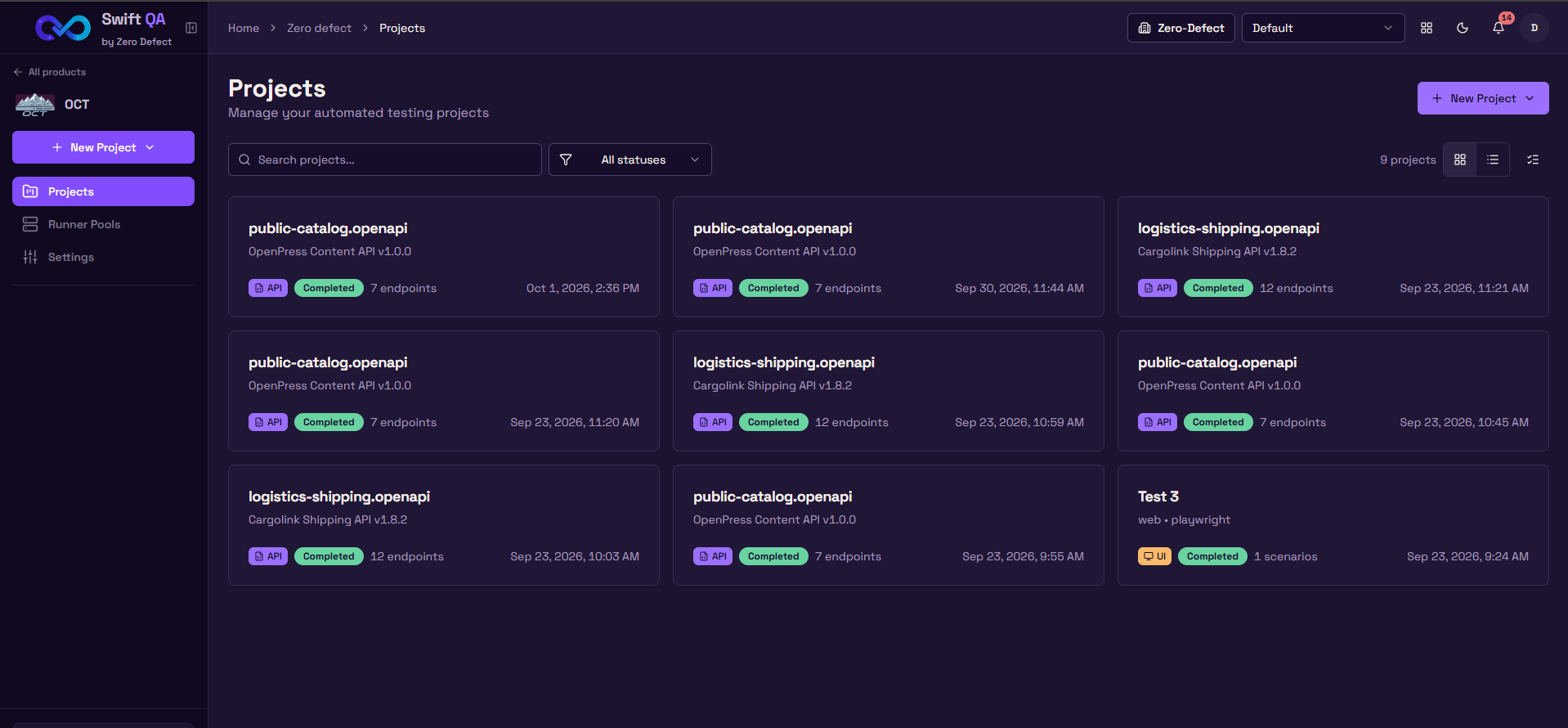
From API files and Gherkin scenarios to validated Playwright and API suites in one workflow. OCT generates the tests, validates each scenario against your running app, and runs them on runner pools triggered by your CI/CD pipeline.
API test suites generated from OpenAPI, Swagger, or Postman files, including negative and edge cases.
UI tests from Gherkin scenarios; each scenario is validated against your running app before it's marked ready. BDD drafts from your requirements are in early access.
SwiftQA explores your running app to find its elements, then generates Playwright tests and checks their syntax.
Your CI/CD pipeline triggers the tests on runner pools, and Insights reads the results your CI already produces.
Scenario: Settlement webhook preserves currency precision
  Given a charge of 49.99 CAD is captured
  When  the charge.succeeded webhook is received
  Then  the payload must contain an ISO-4217 currency
  And   amount must equal 4999 minor units
Turn the test results your CI already produces into clear release readiness—no new test framework needed.
Classify journeys as Critical (100% target), High (98%), Medium (95%), or Low (90%), with states On target, Watch, At risk, Breach, and No tests.
Compares tests reported green by the CI with tests green on the first attempt, so retries can't hide flaky tests.
Generate Locust and k6 load test suites directly from the same OpenAPI, Swagger, or Postman API files.
Release readiness and test health by application or capability and criticality, plus drag-and-drop TV panels that refresh every 5 minutes.
Insights reads the test results your CI already produces and gives managers a single release-readiness view—no new test framework needed.
Risk heatmap by application or capability and criticality—with targets of 100% (Critical), 98% (High), 95% (Medium), and 90% (Low).
Select an application to inspect telemetry
SwiftQA checks your web applications against the WCAG guidelines. Our team reviews the results, and you get a report with findings and recommended fixes.
AA (4.5:1) & AAA (7:1) ratios
Focus traps & order audit
Roles, labels & landmarks
Founded in 2004 as an advanced Hewlett-Packard and PUCRS university research spin-off, Zero-Defect was built where software failure carried serious institutional liability.
Headquartered in Edmonton with corporate incorporation across Canada and the U.S., we build and operate SwiftQA for engineering teams that need dependable release gates.
SwiftQA unifies Zero-Defect's release defense ecosystem under a hardened enterprise perimeter. Manage team workspaces, issue scoped personal access tokens for ephemeral CI/CD runners, and protect deployments operated under Canadian privacy law (PIPEDA).
Clear answers on OCT test generation, Insights release readiness, WCAG accessibility audits, and Zero-Defect.
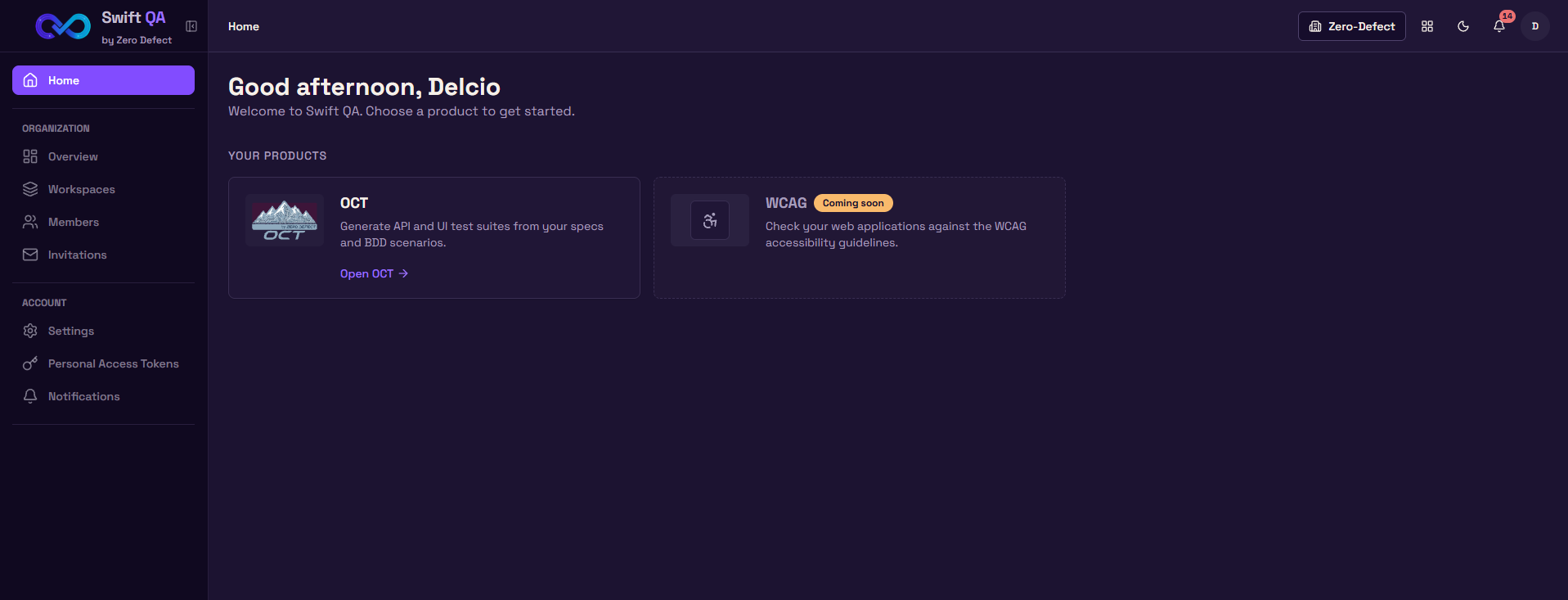
SwiftQA has three products engineered by Zero Defect Test House Inc.:
OCT generates API test suites (including negative and edge cases) and Locust and k6 load tests from OpenAPI, Swagger, or Postman files.
For UI tests from Gherkin scenarios, OCT analyses the scenarios (parses them, maps pages and flows, extracts step details and test data, audits the journey), explores the running app to find its locators, generates Playwright tests, and validates the syntax. Each scenario is validated against the app before it's marked ready, and tests run on runner pools started by your CI/CD pipeline triggers.
Test flows (early access) is OCT's scenario editor. Steps share reusable code, and any step can be given its own code. Passwords and keys stay out of scenarios: steps use named secrets kept in project settings.
BDD drafts (early access) drafts Gherkin scenarios from your requirements so teams can review and validate them before test generation.
No. Insights (early access) reads the test results your CI already produces. It surfaces a business risk gauge (Low below 2%, Moderate 2% to 15%, High above 15%, plus Critical tests failing), critical journeys (protected, flaky, failing, not running, skipped), and a risk heatmap by application or capability and criticality (targets: Critical 100%, High 98%, Medium 95%, Low 90%; states: On target, Watch, At risk, Breach, No tests).
It also compares tests reported green by the CI with tests green on the first attempt ("Can we trust the green?"), tracks open incidents and incidents restored in the last 30 days, and supports drag-and-drop panels with a full-screen team TV view that refreshes every 5 minutes.
SwiftQA WCAG checks web applications against the WCAG guidelines using automated checks plus human review by our team. The deliverable is a clear report listing findings and recommended fixes.
SwiftQA is built and operated by Zero Defect Test House Inc. (www.zero-defect.ca), founded in 2004 as a Hewlett-Packard (HP) / PUCRS technology transfer spin-off. Zero-Defect has its international headquarters in Edmonton, Alberta, Canada and US operations in Coral Gables, Florida.
Our principal quality engineers in Edmonton are available for direct architecture audits.
In 5 business days our engineers use SwiftQA on 10 of your stories and deliver a 2-page risk report with a 45-minute readout. CAD 900 launch price for the first 3 clients, until 31 March 2027.
 SCAN TO AUDIT
Scan the code with your phone camera or reach our engineering command desk directly:
Your diagnostic request is logged. A Zero-Defect specialist will contact you to schedule your audit.